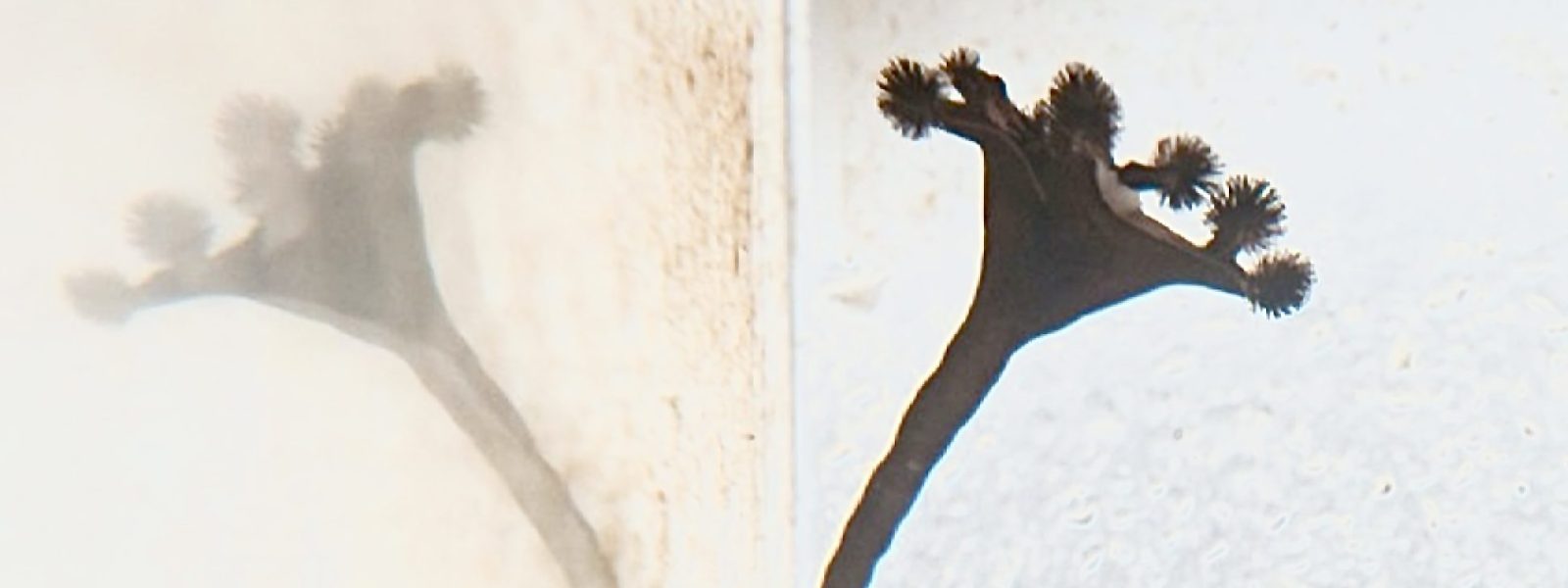
The Champney’s West Aquarium proudly displays a replica of an important geological fossil “Mamsetia manunis” next to its modern-day living relative, “Lucernaria quadricornis” aka, the stalked jellyfish.
The display can be viewed during the aquarium’s operating hours.
Champney’s West Aquarium features tanks with live exhibits, interactive educational programs, and conservation projects designed to engage visitors of all ages. The aquarium, operated by Champney’s West Heritage Group, provides ocean science education to visitors, and promotes sustainability, conservation, and environmental awareness.
About Mamsetia manunis
In 2014 on Newfoundland’s Bonavista Peninsula, Haootia quadriformis, a 565-million-year-old fossil containing the earliest evidence of an animal with muscles, was discovered.
A decade later, researchers from Memorial University have made new discoveries — proving that Newfoundland’s most famous fossil belongs to the stalked jellyfish, or Class Staurozoa, which are common in the waters around the island in the north Atlantic Ocean today.
A research team led by Drs. Duncan McIlroy and Rod Taylor, Department of Earth Sciences, Faculty of Science, discovered the new-to-science organism, Mamsetia manunis, a second species of staurozoan, on the “MUN Surface,” as an area of coastal rock near Port Union, Trinity Bay, is known.
The discovery of Mamsetia and the reclassification of Haootia represent a leap forward in our understanding of early life.
Nicole Squires- Memorial University Gazette
Drs. McIlroy and Taylor, and other researchers involved in the project, including Dr. Suzanne Dufour, biology professor and associate dean of Science (undergraduate) studies at Memorial, recently published a paper in Life documenting the organisms in detail.
Getting Here
After turning off Route 230 at the sign for Champney’s West, continue along the winding road for approximately 2 km, following the coastline as it leads you into the heart of the outport community. Stay to the right at the fork as you approach the village. The road narrows and passes a few scattered homes before bringing you to the waterfront. The Champney’s West Aquarium is located near the end of the main road, next to the community wharf and heritage house. Look for signage as you arrive.
Cultural/Heritage Sites
Champney’s West boasts a rich tapestry of cultural and heritage sites that capture the spirit of Newfoundland’s outport life. At its heart stands the Ella Freeman Heritage House, lovingly restored and opened in 2010, which showcases the efforts of Dr Marjorie Ragosta to collect local genealogies, oral histories, photographs, domestic artifacts, and fishing gear, offering a vivid glimpse into the daily life and traditions of the community. Nearby, the Champney’s West Aquarium, run by the Heritage Group, provides an interactive marine exhibit featuring local species, including a rare blue lobster and touch tanks, enriching visitors’ understanding of the region’s marine culture. The historic Harry Piercey Stage & Wharf, built in the 1940s on Ben Day’s Beach and formally recognized by the Fisheries Heritage Preservation Program, stands as a testament to the enduring fishing traditions that have shaped life in Champney’s West. Together, these sites weave a compelling narrative of maritime heritage, community resilience, and cultural memory on the Bonavista Peninsula.
Trail
The Fox Island Trail is maintained by our partner, Hike Discovery Inc.
| Distance | 5.5km |
| Difficulty | Easy-Moderate |
The Fox Island Trail, located near the community of Champney’s West in Newfoundland and Labrador, is a scenic 5.5 km loop that offers hikers a mix of coastal beauty, forested pathways, and cultural charm. Rated easy to moderate, the trail begins with a gentle climb through wooded areas before opening up to stunning views of Trinity Bay and the nearby Fox Island. Along the route, hikers are treated to rocky cliffs, grassy plateaus, and a peaceful shoreline—perfect for taking a break and enjoying the ocean breeze. One of the highlights of the trail is its passage through the historic fishing village of Champney’s West, where traditional homes and fishing stages reflect the area’s rich heritage. Remnants of old defensive trenches on Fox Island hint at the region’s colonial past. The trail is well-marked and accessible from May to November, making it an ideal half-day adventure for those seeking a blend of natural beauty and local history in a quieter setting than nearby Skerwink.