Migrating Stones …
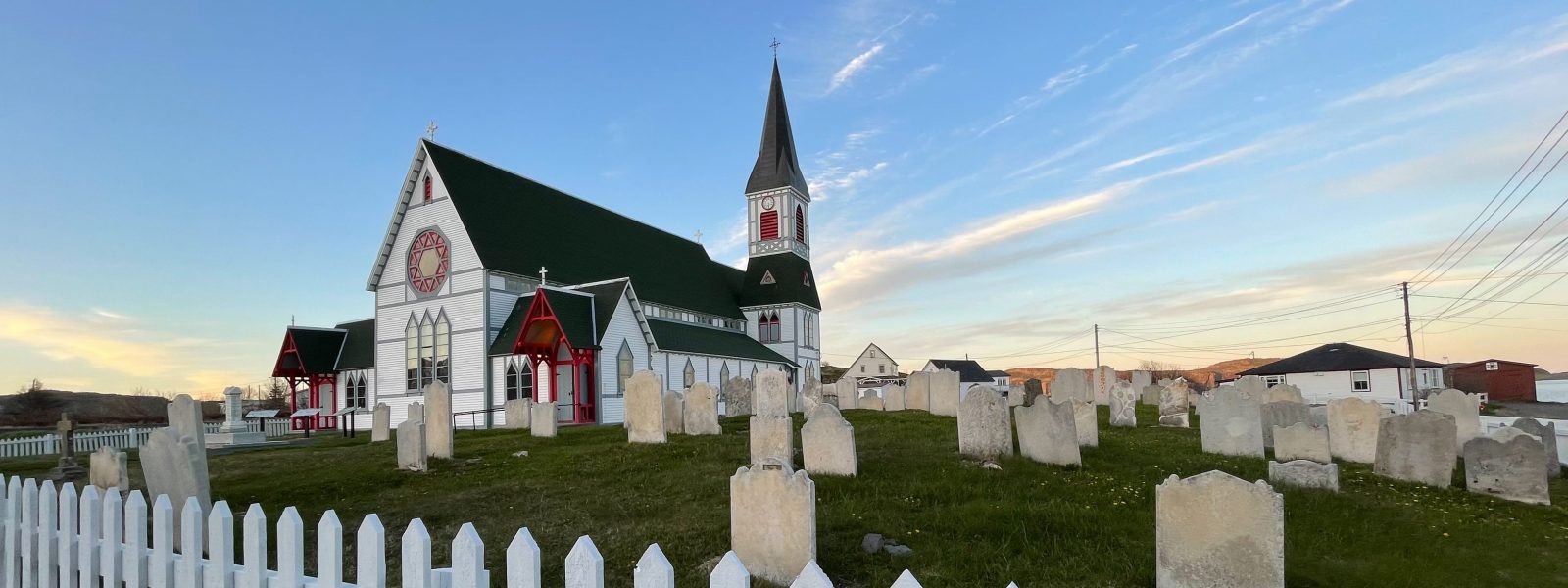
St Paul’s Churchyard has one of the oldest European cemeteries in North America. Thanks to the careful restoration of the headstones, you can learn about some of the area’s earliest settlers. Many of these headstones are made from rock that is not found or quarried in Newfoundland. This is because wealthy early settlers in the seventeenth and eighteenth centuries imported their gravestones from England and Ireland, so that their final resting place could be marked with limestone and later marble. Limestone weathers especially poorly in Newfoundland’s salty wind and driving rain. Look for the marks of centuries of erosion as you visit the graves. Several gravestones in this cemetery are made from imported sandstone, possibly from Nova Scotia. Can you find them?
The gravestones are not the only rocks that were migrated here from the other side of the Atlantic.
If you look across the townscape, you’ll see a large brick house built by the Lesters, the wealthiest and most powerful merchant family on the island in the eighteenth and nineteenth centuries. They imported the costly brick, made by hand from English clay. The colour of brick is determined by the chemical composition of the clay, and the fuel and oxygen levels used to fire them. The red brick on the Lester-Garland house gets its red colour from iron oxide and likely came from a Dorsetshire brickworks.
Salt and Sugar …
One of the most important minerals in this The burial record of the Beothuk man John August, alongside those of other Trinity residents, in the year 1788. Credit: Courtesy of the Trinity Historical Society Archive area’s history is one that was only rarely produced here: salt. Immense quantities of salt were required to cure the codfish that were caught and dried by fishers in Newfoundland and exported by merchants.
Salt cod was one of the first truly global commodities, and one of the British empire’s most lucrative trades. The best quality cod was cured with sea salt produced in the salt marshes of Southern Europe. It was exported to the Iberian market in exchange for luxury goods like wine, dried fruit, and silver. The worst quality cod was often maggoty and ‘salt burned’ (overcured) and was sometimes produced with impure salt raked by enslaved people in places like the Turks and Grand Caicos Islands. This cod constituted up to eighty percent of the protein consumed by enslaved people in the sugar plantations of the British Caribbean. The town of Trinity was a vital node in this triangle trade, part of an entangled and troubling global history.
While you are here, look for the traditional salt-box shape of many of Trinity’s heritage buildings and homes, named for the box in which household salt would be kept in the eighteenth century.
Getting Here
Take Route 230 and exit at the Trinity turnoff (Route 239).
Attractions
The Town of Trinity is the site of a seasonal theatre company, an extensive historic district and numerous amenities.
Cultural Attractions
Cultural Heritage Sites in Trinity:
| St. Paul’s Anglican Cathedral, Trinity | A timber framed church built between 1892 and 1894 in the Gothic Revival style of architecture, featuring a tower with a spire. |
| Roman Catholic Church of the Most Holy Trinity, Trinity | A timber famed church built in the Gothic Revival style of architecture in 1833. |
Historical Attractions
Historical Heritage Sites in Trinity:
| Trinity Visitor Centre Provincial Historic Site | This site features a new interactive exhibit telling the colourful story of Trinity’s past and present. |
| Mercantile Premises Provincial Historic Site | The business hub for three merchant families over 150 years. This Trinity counting house provides a glimpse at seaport life in the 1700s. |
| Hiscock House Provincial Historic Site | This site presents life in Trinity in the late 19th and early 20th centuries and features the home of Emma Hiscock (circa 1910), a widowed entrepreneur providing for and raising her family. |
| Lester – Garland House, Trinity Historical Society Site | A reconstructed brick Georgian residence used as a museum and education centre. |
| The Trinity Museum, Trinity Historical Society Site | Built in the 1880s in saltbox style by the DeGrish Family, the building has been used as a museum since 1967. |
| The Cooperage, Trinity Historical Society Site | This site is functional living museum where you can see a cooper’s skills at work. |
| The Green Family Forge, Trinity Historical Society Site | This site is fully operational as a living history museum. The Green Family practiced as blacksmiths in Trinity since 1750. |
| Fort Point Military Site | Commonly referred to as Admirals Point, this site was built by the British in 1748 and explores a fortification used to protect Trinity Harbour. |